Quick answer: Two phone calls find most free equipment. Call the Eldercare Locator at 1-800-677-1116 for your Area Agency on Aging, then call your state Assistive Technology Act program, which runs device loan and reuse services in every state and territory. Medicare pays 80 percent of covered equipment but gives nothing away.
Walkers, wheelchairs, shower chairs and hospital beds move through a quiet secondhand economy. Somebody recovers, or dies, and the equipment goes back into a closet.
You have to know who to ask. Here is the order to ask in.
Start with two phone calls
Call the Eldercare Locator: 1-800-677-1116. It is a public service of the Administration for Community Living. Trained staff answer by phone, text, chat or email.
Ask for your Area Agency on Aging. There is one for every county in the country, and they know which local groups keep loan closets.
Then call your state Assistive Technology Act program. Every state and territory has one, funded through the Assistive Technology Act. The AT3 Center lists each program with a phone number, an email and a website.
Ask specifically for three services. Device loan lets you borrow equipment to try it. Device demonstration lets you compare two options before you buy. Device reutilization, or reuse, is the program that gives away refurbished equipment.
Many state AT programs also run a financial loan program, which lends money at low interest for equipment you must buy new.
What Medicare covers, and what it does not
Medicare does not give equipment away. It pays part of the cost of certain items.
Part B covers durable medical equipment when your doctor orders it for use in your home. Medicare defines that as equipment that is durable, used for a medical reason, normally useful only to someone sick or injured, used in your home, and expected to last at least three years.
The covered list includes canes, commode chairs, crutches, hospital beds, oxygen equipment, walkers, and wheelchairs and scooters.
After you meet the Part B deductible, you pay 20 percent of the Medicare-approved amount when the supplier accepts assignment. Ask every supplier two questions: are you enrolled in Medicare, and will you accept assignment.
Depending on the item, you may rent, buy, or choose. Some rented items become your property after a set number of rental payments.
What Part B will not pay for: grab bars, shower chairs, bath benches, ramps, stair lifts, walk-in tubs and other home modifications. Those are not durable medical equipment. Our guide on what Medicare pays for home modifications explains the exceptions inside Medicare Advantage plans.
Medicaid and HCBS waivers
If income and assets are low, Medicaid is the strongest option. It covers durable medical equipment, and it often covers more than Medicare does.
Home and community based services let people get care at home instead of in an institution. CMS reports that 86.2 percent of long-term services and supports users received HCBS in 2021.
Waivers vary enormously by state. Some pay for bathroom modifications, ramps and specialized equipment that regular Medicaid will not touch.
Call your state Medicaid office and ask for the HCBS waiver serving older adults. Ask whether there is a waiting list, because many states have one.
Loan closets
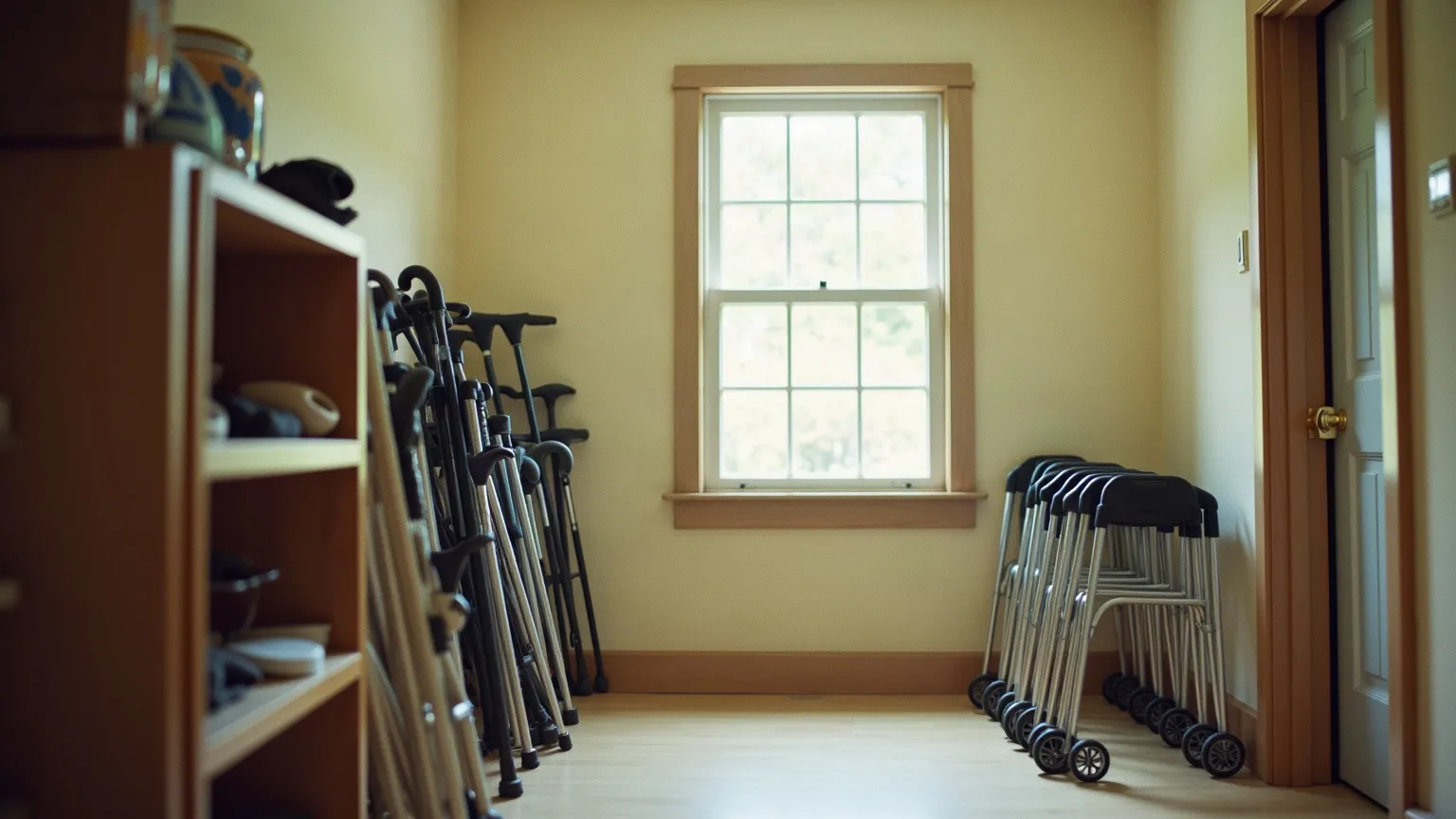
A loan closet is a local stock of donated equipment, cleaned and lent out for free. Expect walkers, wheelchairs, commodes, crutches, shower chairs and bath benches.
Some closets ask for a refundable deposit or a return date. Most do not check income.
Ask your Area Agency on Aging for the list. Also ask these sources directly:
- Disease-specific nonprofits. Local chapters serving ALS, multiple sclerosis, Parkinson’s disease and muscular dystrophy often keep equipment for the people they serve. Call the local chapter, not the national office.
- Service clubs. Lions Clubs, Kiwanis, Rotary and Knights of Columbus chapters run equipment programs in many towns.
- Churches and synagogues. Congregations often hold equipment for members and neighbors.
- Senior centers and independent living centers.
- Hospice organizations, which sometimes redistribute returned equipment.
- Local fire departments, which occasionally stock loaner equipment.
Community and online sources
Buy Nothing groups on Facebook are the fastest free option in many towns. Post what you need, in your own words, and be specific about size.
Also try Freecycle, Nextdoor and the free section of Craigslist. Thrift stores run by Goodwill, the Salvation Army and Habitat for Humanity ReStore sometimes carry equipment cheaply.
Ask at the discharge desk when someone leaves a hospital or rehab. Staff know where returned equipment goes.
Veterans and rural homeowners
Veterans
Veterans have their own track, and it is usually better funded.
Ask the VA prosthetics office at your local VA facility about equipment. For home changes, the HISA benefit pays a lifetime maximum of $6,800 for a service-connected disability, or $2,000 in other qualifying cases.
HISA excludes portable ramps, porch lifts and stair glides, so plan for permanent work instead.
Rural homeowners
USDA Rural Development runs the Section 504 Home Repair program. Homeowners aged 62 and older with very low income can get a grant of up to $10,000 to remove health and safety hazards.
Loans go up to $40,000 at a fixed 1 percent for 20 years, and a loan and grant can combine to $50,000. A grant must be repaid if the home sells within three years.
Applications are accepted year round at your local Rural Development office. Our guide to grants for home modifications covers this and other programs in detail.
How to ask so you actually get it
Loan closets run on volunteers. A clear, short request gets answered first.
Say who needs it, what you need, and the size. “My mother is 5 foot 2 and weighs 140 pounds, and she needs a shower chair with a back” works. “Any bath stuff?” does not.
Give a return date if you can. Closets lend more freely when they know the item comes back.
Ask to be put on a waiting list if the item is out. Equipment cycles back within weeks.
Call rather than email. Many closets are staffed a few hours a week, and a voicemail beats a form.
Say yes to a slightly different model. A walker with the wrong hand grips is fixable. Waiting three months is not.
Check used equipment before you accept it
Free equipment that does not fit is worse than nothing.
- Check the weight capacity label. Never guess.
- Check adjustment range. A walker or shower chair must fit the user’s height.
- Check for rust, cracked plastic and missing rubber tips.
- Ask the manufacture date on anything safety-critical. For bed rails in particular, current federal safety rules apply only to rails made after August 21, 2023, and our bed rails guide explains why that matters.
- Ask whether the item was recalled. Check the model number at CPSC’s recall database.
- Clean everything before use.
If you are being offered a used hospital bed, read our hospital bed for home guide first, because Medicare may cover a new one with a doctor’s order.
Caregivers can get help too
The Older Americans Act funds caregiver support through the same Area Agency on Aging network. That can include respite, training and sometimes supplies.
Our guide to the National Family Caregiver Support Program covers what it pays for and how to apply.
Bottom line
Call 1-800-677-1116 first, then your state Assistive Technology Act program, then local loan closets through your Area Agency on Aging. Use Medicare for the big covered items like hospital beds and wheelchairs, and expect to pay 20 percent after the deductible. Use Medicaid HCBS waivers if income is low, and VA or USDA programs if you qualify. Inspect the weight label and the date on anything used before you take it home.
Frequently asked questions
Where can I get free medical equipment near me?
Call the Eldercare Locator at 1-800-677-1116. It is a public service of the Administration for Community Living and it connects you to your Area Agency on Aging, which knows the loan closets in your county. Then call your state Assistive Technology Act program, which runs device loan and device reuse services.
Does Medicare give you free equipment?
No, but it pays most of the cost of covered items. After the Part B deductible, you pay 20 percent of the Medicare-approved amount when the supplier accepts assignment. Part B covers durable medical equipment such as walkers, canes, commode chairs, hospital beds and wheelchairs when a doctor orders it for use at home.
What equipment does Medicare not cover?
Anything that is not durable medical equipment. That rules out grab bars, shower chairs, bath benches, stair lifts, walk-in tubs, ramps and other home modifications, because they are not medically necessary equipment under Part B rules. Some Medicare Advantage plans add a home-safety or over-the-counter allowance, so check with your plan.
What is a loan closet?
A local stock of donated, cleaned equipment that a nonprofit lends out at no charge. Walkers, wheelchairs, commodes, shower chairs and crutches are the usual items. Some closets ask for a deposit or a return date. Your Area Agency on Aging can name the ones near you.
Can I get free equipment through Medicaid?
Often yes, depending on your state. Medicaid covers durable medical equipment, and home and community based services waivers can cover items and home changes that regular Medicaid does not. CMS reports 86.2 percent of long-term services and supports users received HCBS in 2021. Rules vary by state, so call your state Medicaid office.
Sources
- Eldercare Locator — Administration for Community Living — checked 2026-09-02
- AT3 Center — find your state Assistive Technology Act program — checked 2026-09-02
- Medicare.gov — Durable medical equipment (DME) coverage — checked 2026-09-02
- Medicare.gov — Commode chairs coverage — checked 2026-09-02
- Medicaid.gov — Home & Community Based Services — checked 2026-09-02
- VA — Home Improvements and Structural Alterations (HISA) benefit amounts — checked 2026-09-02
- USDA Rural Development — Single Family Housing Repair Loans & Grants — checked 2026-09-02
- USAging — Area Agencies on Aging network — checked 2026-09-02